















The Best Meteor Shower Award Goes To...
Posted on December 8, 2023
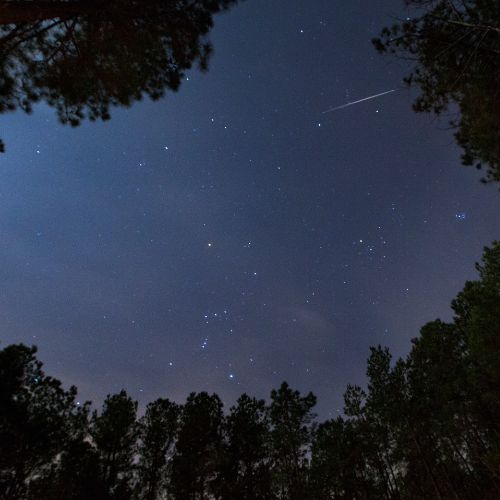
The Geminids meteor shower is widely regarded as one of the Northern Hemisphere's strongest and most reliable annual meteor showers. However, it's often overlooked because it takes place in the winter, which typically doesn’t present the best stargazing weather. Despite chilly temps, this year could be the best show yet, so serious stargazers (or anyone craving some winter wonder) might want to bundle up and brave the elements.
About the Geminids
The Geminids first showed up in the mid-1800s. At that time, only about 10-20 meteors per hour were visible. Since then, the Geminids have grown into a major stargazing event. Now, viewers can see up to 120 meteors per hour in clear conditions. The Geminids are especially bright and can appear white, yellow, or green, making for a spectacular, multicolored lightshow!
While most meteor showers are the product of comets, the Geminids are caused by a strange asteroid called 3200 Phaethon. Scientists don’t fully understand Phaethon—it looks like an asteroid, but it behaves like a comet. It has a comet-like elliptical orbit and brightens and forms a tail as it gets closer to the sun. The pieces of Phaethon that break off (the same pieces that form the Geminids) are also much more dense than the dust flakes from comets. Check out this 2023 NASA article that highlights just how unusual 3200 Phaethon is.
Why This Could Be the Best Year Yet
This year, the Geminids will peak on the evening of Wednesday, December 13, which aligns almost perfectly with the new moon. Little to no moonlight makes it much easier to spot meteors, especially when the meteor shower is as reliable as the Geminids.
Viewing Tips
-If it’s cloudy out, just skip it. Keep your eye on your local weather forecast as we get closer to the peak. (At the time of this writing, the weather forecast is mostly clear for this coming Wednesday night in Sawyer, MI.)
-The Geminids start showing up around 9 or 10 pm and last through the night, peaking around 2 am.
-Head far away from city lights or street lights. Look for a spot with an unobstructed view of the dark, open sky without light pollution.
-Give your eyes time to adjust. It takes about 30 minutes for your eyes to fully adapt to the dark.
-Lay flat on your back and relax. You don’t really need to look at any specific spot. According to NASA, the Geminids are visible throughout the night sky.
-Be prepared. Bundle up and pack a warm drink.
-Bring someone with you. Two (or more) sets of eyes are better than one. And, depending on your sleeping habits…you might need someone to wake you up.
Busy next Wednesday night? No worries! The Geminids will stay active until December 24, so even if you miss the peak, you can still try your luck on any clear night until then. Happy gazing!