















Walking in a Webby Wonderland
Posted on August 18, 2023
Picture this- you’re waltzing through the woods, enjoying the late summer foliage and warm weather, when SMACK! You find yourself face-first in a sticky spiderweb, and you’re 99.9% sure the spider that used to be in that web is now in your hair.
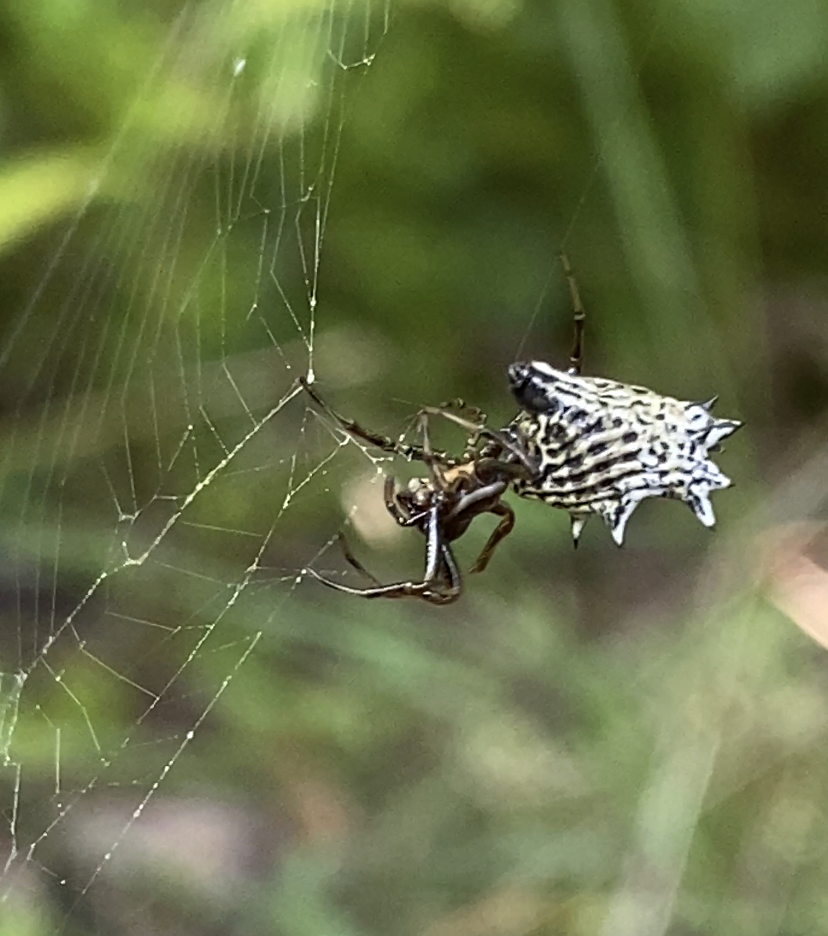
This time of year, that web might belong to the spider depicted on this page: the spined micrathena (Micrathena gracilis), or the spiny orb-weaver. These spiders are most active towards the end of summer through early fall and are very common in wooded areas. They're notorious for spinning their circular webs at about eye level, directly in the middle of a trail. Sorry, hikers...we've all gotta eat!
The spikes are thought to deter predators from eating these spiders (seems legit...they definitely deter us). While their appearance may be unsettling, you don’t need to run screaming in the other direction, vowing to never hike again. Despite their unique shape, these spiders are harmless to humans. They typically choose to flee rather than fight, and even if they do bite—they aren't venomous. They might, however, make some noise. Spined micrathena are able to emit a low-pitched buzz (called stridulating) when they feel threatened. And no, we won't be testing that out.
These spiders are common from the Northern and Eastern US all the way down to Costa Rica. Females (like the spider pictured) have five pairs of those trademark spikes and are typically black with white markings, but their coloring varies. Some are almost entirely white with orange or brown spots. Males look completely different; they're brown and white and have an elongated, flattened abdomen ending in a blunt edge.
Though not rare, many people have never seen one of these odd-looking arachnids because they're quite small. Females range from 0.25 - 0.5 inches in total body length, and males are about half that size. The name "micrathena" is a combination of the word "micro" (meaning extremely small) and "Athena", the Greek goddess of war. It's often overlooked that Athena is also associated with crafts, especially spinning and weaving, which is how this orb-weaver came to share her name.
So, next time you unexpectedly take a spiderweb to the face, take a quick peek at any remaining web on either side of the trail to see if you can spot this cool-looking creature! And no squashing!