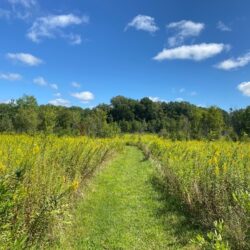
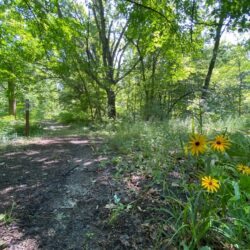
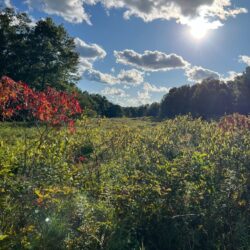
Ten years ago, Chikaming Open Lands protected its first five acres. Today, COL works with landowners at the local level and has protected nearly 1000 acres. We are achieving our mission — Protecting the Land, Preserving Our Heritage. With more than 800 members supporting this mission, we are well on our way to meeting our goal of 1,500 acres preserved by 2012.
Our protected lands fall into two categories: preserves (lands owned by COL) and conservation easements (lands owned by private landowners).
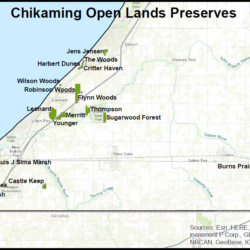
COL's preserves are owned by Chikaming Open Lands. There are currently four preserves: the Louis J. Sima Great Lakes Marsh, Eleanor O'Connor Wilson Woods, Grand Beach Marsh, and Robinson Woods. Please visit the following link to learn more about the Louis J. Sima Great Lakes Marsh. Information about the other preserves is provided below.
Click the horizontal bar below to learn more about the Eleanor O'Connor Wilson Woods. If clicking a bar does not open or close the preserve's description, please enable javascripts for this site.
In 2001, Chikaming Open Lands completed a purchase and sales agreement with the trustees of the Eleanor O'Connor Wilson Trust to acquire 5-acres of high quality back dune forest. This property has scenic, natural and scientific values of importance to our land trust and to the public. In addition, it contains natural habitat characteristic of a sand dune community in which wildlife and plants, or the ecosystems which support them, thrive in an undisturbed state.
In late 2009, COL acquired Grand Beach Marsh through a transfer from The Nature Conservancy. Originally established in late 1984, Grand Beach Marsh Preserve is an 11-acre gem that provides an outstanding example of a globally rare coastal plain marsh. Several rare or declining species can be found in this habitat, including the Virginia meadow-beauty, Olympia marble butterfly, and spatulate-leaved sundew.
One of the earliest properties in Michigan protected by The Nature Conservancy, the 80-acre Robinson Woods Preserve in Chikaming Township features steep slopes cut by streams that run through virgin and second-growth forest on former agricultural lands and floodplains. The preserve was named after William and Jean C. Robinson who gave The Nature Conservancy 65 acres in 1968 and an additional 15 acres in 1973. COL acquired this property through a transfer in late 2009.
COL's other protected properties constitute conservation easements and are privately held lands. Conservation easements are voluntary legal agreements between landholders and Chikaming Open Lands that permanently limit the uses of the land in order to protect its natural features. You can learn more about how conservation easements work here. Information about COL's conservation easements is provided below. More pictures of these easements can be viewed in the COL Photo Gallery.
Click the horizontal bars below to learn more about COL's conservation easements. If clicking a bar does not open or close an easement's description, please enable javascripts for this site.
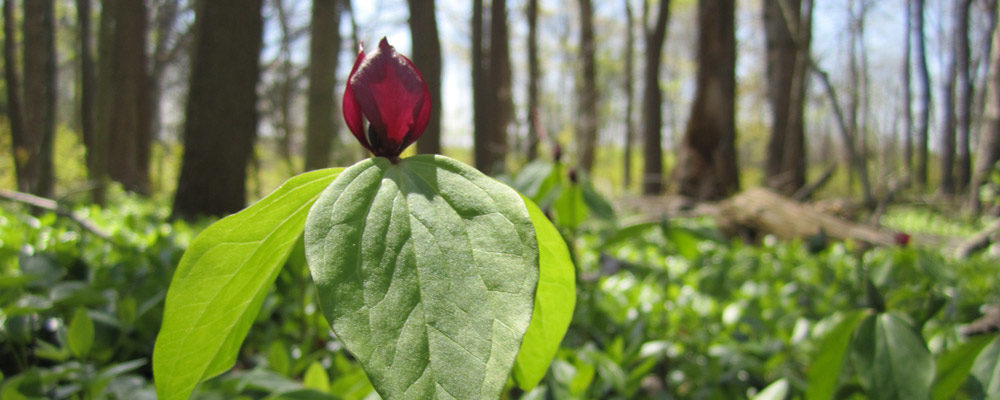
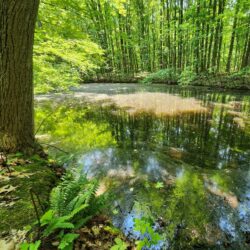
The Blackjack Conservation Easement covers 9.4 Acres. This property is a diverse mixture of tree species of various age and size including older growth forest, dominated by mature oaks and tulip poplars, many with diameters over 24 inches at chest height. The property also includes a wonderful variety of wildflowers, including the state threatened prairie trillium and a significant population of club moss. The presence of numerous vernal pools, forested wetlands, and an unnamed stream provide an array of habitats for mammals, reptiles, amphibians, and aquatic invertebrates. It is an important stopover and breeding site for many species of birds, including the Long-Eared Owl, Cerulean Warbler, Louisiana Waterthrush, and Hooded Warbler, rare birds known to be taking advantage of the adjacent Robinson Preserve just to the east of the property.
Picture and description forthcoming.
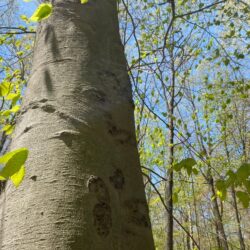
The Deer Creek Easement preserves 7.5 acres of property that has been in the family of Doug and Valerie Miller family for at least 50 years. The forest contains beech, maple, tulip, shagbark hickory, and white oak and is split by Deer Creek. This type of forest cover, combined with a waterway, is an important stopping point and breeding ground for many species of birds. Additionally, the woods are part of a larger green infrastructure that covers adjacent properties throughout southwest Berrien County. This property also includes wetlands that are important sources of groundwater recharge. Protecting property along a tributary of the Galien River also protects water quality in the watershed.
The Covenant Farm Easement protects 29 acres of natural and managed forest. Purchased by five families in 1979, the property is now held by the Covenant Farm Corporation, which includes seven families and is currently used for recreation and wildlife habitat. The property consists of uplands and ravines. The west natural area is cut north to south by a 30-foot deep ravine occupied by a small unnamed stream which joins the Galien River to the south. The southeast natural area has an oxbow of the Galien River and overlooks the 50-foot deep Galien River valley. The oxbow is seasonally flooded. Natural areas are covered by a diverse mixture of tree species of various age and size and there is a wonderful variety of wildflowers, including the unusual American columbo (Swertia caroliniensis) which is known to have been sighted in only two locations in Berrien County, and the state threatened prairie trillium (Trillium recurvatum). Tree species include beech, sugar maple, shagbark hickory, oaks, hop hornbeam, and sycamore.
The Deer Creek Easement preserves 7.5 acres of property that has been in the family of Doug and Valerie Miller family for at least 50 years. The forest contains beech, maple, tulip, shagbark hickory, and white oak and is split by Deer Creek. This type of forest cover, combined with a waterway, is an important stopping point and breeding ground for many species of birds. Additionally, the woods are part of a larger green infrastructure that covers adjacent properties throughout southwest Berrien County. This property also includes wetlands that are important sources of groundwater recharge. Protecting property along a tributary of the Galien River also protects water quality in the watershed.
In 2004, George and Andrea Platz donated a conservation easement of 10-acres to Chikaming Open Lands. Old growth beech/maple forest is extremely rare statewide and it provides vital habitat to many endangered plant and avian species. This land has significant conservation value and because it abuts Warren Woods and is on a tributary of the Galien River, its value is multiplied several times.
The El Topo Easement protects 3.5 acres on the main branch of the Galien River in the Galien River watershed. This area is known to bird watchers who look for the Cerulean Warbler which are found in densely wooded river valleys as found on El Topo. The Galien River at this property is a low gradient (relatively flat) stream, deep in places with a soft bottom. The property, with its deep river valley and steep hills is prone to flashiness — the stream’s rapid rise after a heavy rain. There is an extensive migration of steelhead during the spring and the fall. The pond on the property has a delightful array of frogs and aquatic insects. Green and bull frogs are found along the pond margins along with spring peepers and cricket frogs. The most unusual plant on El Topo is the prairie trillium (Trillium recurvatum), a special concern species, which is found in the floodplain. There are thousands of the prairie trillium here. In Berrien County the prairie trillium is locally abundant where there is an intact, healthy, mature forest like on this property. Little is known of the history of the land use on the property except that the previous owner, Richard Olsen, an eccentric local artist, used the property for his own personal canvas, sculpting viewing benches and art pieces which would allow the viewer to really appreciate his surroundings. The Crimmins family has placed the conservation easement on the northern portion of their property, which consists of a bluff and floodplain along the Galien River. The side slope of the bluff is very steep — 40 to 50 feet — and dramatic, with a view of the floodplain below.
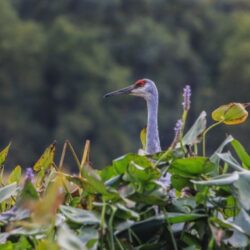
The Galien Meadow Conservation Easement covers 33 acres. The property, owned by Diane DeWitt, was acquired nearly twenty years ago as a place offering solitude and peace for this retired special education teacher. Diane was attracted to the property for its rolling terrain and small pond. Historically a portion of the property was farmed, then Diane enrolled one of the fields into the Conservation Reserve Program. The permanent grass cover has reduced soil erosion on the steep slopes, and provided wonderful wildlife habitat. Deer, fox, turkeys, and ducks can be found living on the property, as well as a pair of sand hill cranes that live nearby.
The Hanover Easement is characteristic of a native forested floodplain. Tree species include sugar maple, sycamore, ash, black walnut, and cottonwood. Understory species include spicebush and sassafras. These plant communities are in a relatively natural and undisturbed condition and support the full range of wildlife species found in these habitat types. This property also contains natural wetland areas within the watershed of the Galien River that provide habitat for aquatic invertebrates, reptiles, amphibians, and ensure quality water resources for the area. The property includes 75 feet of frontage on the Galien River and two ponds that connect to the river in flood stage.
The Happy Tails Easement protects 7.25 acres of open floodplain forest whose dominant vegetation is walnut and sycamore. There is an upland area with red oak, beech, and maple in the over story and ironwood dominating the under-story. The upland plant community is in a relatively natural and undisturbed condition and supports the full range of wildlife species found in this habitat type. The property includes 550 feet of frontage on the Galien River. Protecting the natural vegetation of this property will reduce overland flow, reduce soil erosion, increase infiltration, and improve water quality.
The Jasper Buffer Easement establishes a permanent riparian buffer preserving over a quarter mile of stream. This 3-acre parcel has both grassland and woodland and is located along Deer Creek. Since Chikaming Open Lands is working with a grant that is tied to the Clean Water Act for this conservation easement, the acreage’s close proximity to Deer Creek was an important factor. Protecting the vegetation in this riparian buffer zone helps naturally filter any runoff from the adjacent field.
The Weesaw Forty Conservation Easement is located in Weesaw Township and covers 40 acres of agricultural and forested land, which is an important part of the scenic, rural, and natural character of the area. This property is among the best, most productive agricultural areas in Berrien County. Approximately 33 acres is used for growing row crops. In order to preserve the agricultural values, all agriculture activities are subject to a conservation plan prepared by the USDA which is then provided to COL. The forested areas are comprised of two stands located at opposite ends of the property which include a small upland woods dominated by sugar maple, black cherry, and box elder, and a forested wetland with trees in all diameter classes. Pawpaw and spicebush are plentiful in the understory and the state threatened Prairie Trillium is also found here.
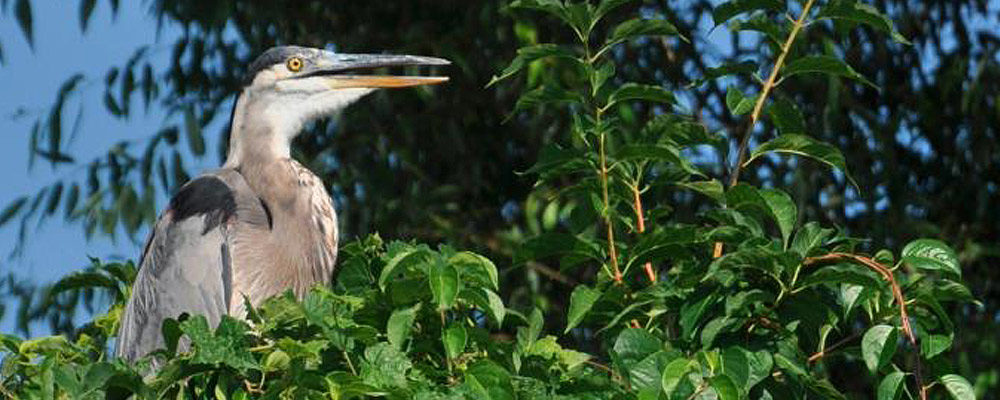
The Johnson’s Creek Trail Easement and Flynn Conservation Easement combined cover 71 acres. Both properties contain significant lengths of the Galien River, are heavily forested, and provide prime habitat for the state-threatened Prairie Trillium, numerous bird species, and other wildlife. The properties are a mixture of upland forest, forested ravines, and floodplain forest. The forests are beech/sugar maple mature forests, but are particularly diverse in both tree and ground cover species and there is evidence of a vernal pool. Wooded areas are diverse in species, age class, and structure and attract a wide variety of wildlife species. Orioles, wood thrush, Indigo Bunting, wood ducks, wild turkeys, and various species of woodpeckers, warblers, herons, ducks, hawks, and owls are a few of the birds that have been sighted on the properties. Many species of mammals, reptiles, and amphibians also benefit from the diverse habitat and the rural nature of the neighboring properties.
Maple Haven Easement protects 4.5 acres of southern mesic forest community dominated by maple, tulip, and ash along with black cherry and American beech. The under-story includes spicebush and pawpaw. A wide variety of spring ephemerals is also present. The property includes important natural and riparian lands within the watershed of Dowling Creek, a tributary to the Galien River. Protection of this property in its natural and open space condition helps to ensure the quality and quantity of water resources for the area. Maple Haven includes approximately 500 feet of an ephemeral stream and contains significant natural habitat in which fish, wildlife, plants, or the ecosystems that support them, thrive in a natural state.
The Mt. Zion prairie conservation easement covers 11.7 acres. The property, owned by Daniel Whitman, is part of the Galien Watershed. Though farmed at one time, Dan has planted legumes, prairie forbs, and natural grasses to attract wildlife back to the area. This bio-diverse property includes a wooded area, wetland, and pond which are likely habitats for at-risk species including Blanchard’s Cricket Frog, the state-threatened Spotted Turtle, and the Eastern Massasauga Rattlesnake. The grassland area provides nesting, brood-rearing, and roosting cover for quail, pheasants, and wild turkeys.
The Martin and Elsie Priest Conservation Easement protects 8.3 acres of gently rolling upland and floodplain forest along Deer Creek and was purchased by the family in 1887 as part of a working farm. The family continues to farm the surrounding area. A shallow river valley borders Deer Creek, which flows south to north through the property. Upland forest species such as sugar maple, beech, basswood, musclewood, sassafras, and red oak occur more frequently on the slope and ridge above Deer Creek, while floodplain species such as black walnut, sycamore, and willow are more frequent in the floodplain surrounding the creek. The woods along Deer Creek form an attractive corridor for wildlife that extends to the north on neighboring properties. The presence of ephemeral wetlands (vernal pools) provides important habitat for aquatic invertebrate, reptile and amphibian species which depend on seasonal water pools. Deer Creek is a tributary of the Galien River and joins the Galien about one mile from the Property.
The Riverside Woodland Conservation Easement protects approximately 31.3 acres of forest land currently used for recreation and wildlife habitat. There is a wonderful variety of wildflowers, including the state threatened Prairie Trillium. Pileated Woodpeckers, wood ducks, orioles, and wood thrush are all known to nest on site. Evidence of turkeys, owls, and hawks have also been noted. Vernal pools are present on the property. Most notably there is a large area in the center of the property encompassing nearly 3.5 acres that has been identified as a forested wetland in the National Wetlands Inventory. Such areas provide important habitat for aquatic invertebrates, amphibians, reptiles, and aquatic vegetation.
The Silent Giants Conservation Easement covers approximately 18 acres of woods and wetlands in Three Oaks Township. Two thirds of the property is considered forested wetland, but it also contains somewhat drier, mesic woods and a nice array of native wildflowers, including the state-threatened Prairie Trillium. This type of forest cover and wetlands are important stopover and breeding sites for many species of birds. The wetlands provide a particularly important habitat for aquatic invertebrates, reptiles, amphibians, and aquatic vegetation. Though not directly connected, the property lies between two streams, both tributaries of the Galien River. This conservation easement enhances the ecological value of this corridor in the watershed.
Squaw Creek Easement protects 77 acres of native forest that includes more than 20 species of trees and shrubs. There are wetlands, vernal pools, and diverse wildlife habitat and riparian features to the property, with 1800 feet of valley containing a meandering, terraced stream. It is one of the last remaining blocks of agricultural lands in New Buffalo Township, containing 60% sols designated prime farmland.
The Sanctuary Conservation Easement protects 31 acres, including floodplain forest along Pokagon (or Bertrand) creek and upland meadow. The creek has been found to support a remnant population of brook trout (Salvelinus fontinalis) and rainbow trout (Oncorhynchus mykiss). Both species thrive in cold, clear, high-quality streams. The floodplain is dominated by forest, with mixed-age species of red and black Oak, Cherry, Beech and various Maples. The High Meadow is a restoration prairie that is regularly burned. Fernwood Botanical Gardens, who prepared the management plan, states it is the intention of the Sanctuary to develop this area as high-quality grassland consisting of short- to mid-height native grasses and forbs. This property is located in proximity to the Madeline Bertrand County Park.
The Three Corners Easement protects 3 acres of land that includes a small wetland. The easement protects the vegetation around the wetland body as well. The property contains significant native species and wildlife habitat. The remainder of the property is similarly preserved through a conservation easement with the Michigan Department of Agriculture.
Many of us have a desire to protect the places that enrich our lives, leaving a legacy of open land and natural habitat for future generations to enjoy.
Learn more about how you can preserve your land.
Click to view a larger version of this map in a new window: